Complete guide to FIBC jumbo bags — types A/B/C/D, construction styles (U-panel, 4-panel, circular, baffle), sizes 90x90x110cm to 95x95x120cm, SWL 500kg to 2000kg, safety factors 5:1 & 6:1, and price guide. Direct FIBC manufacturer from Morbi, Gujarat, India.
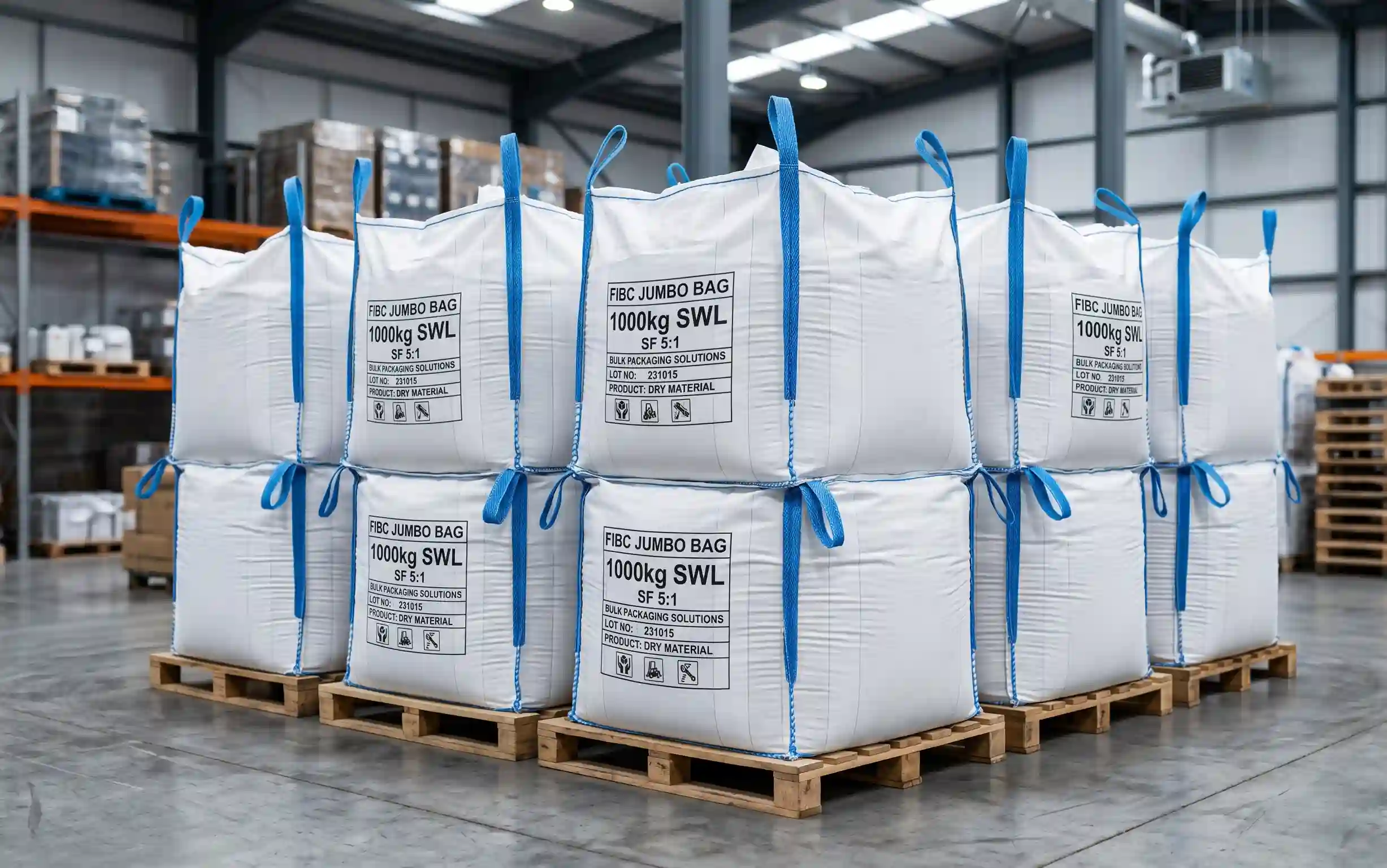
A FIBC (Flexible Intermediate Bulk Container) jumbo bag is a large industrial woven polypropylene bag designed for storing and transporting bulk dry, flowable materials. Also known as bulk bags, big bags, or super sacks, FIBC bags are the most efficient bulk packaging solution across agriculture, chemicals, construction, food, and mining industries worldwide.
The global FIBC market is valued at approximately $7.84 billion and growing at a CAGR of 4.5% globally and 9.2% domestically in India [^154^]. India accounts for 66% of global FIBC exports, making Indian manufacturers key suppliers to USA, Europe, Middle East, and Southeast Asian markets [^152^]. FIBC bags typically handle loads from 500kg to 2000kg with safety factors of 5:1 for single-use and 6:1 for multi-use applications [^160^][^159^].
Flexible Intermediate Bulk Container
Woven Polypropylene (PP)
500kg – 2000kg+
90x90x110cm · 95x95x120cm
5:1 (Single) · 6:1 (Multi)
ISO 21898 · IS 14738 · UN
U-Panel · 4-Panel · Circular · Baffle
Type A · B · C · D
PE Liner · Food Grade
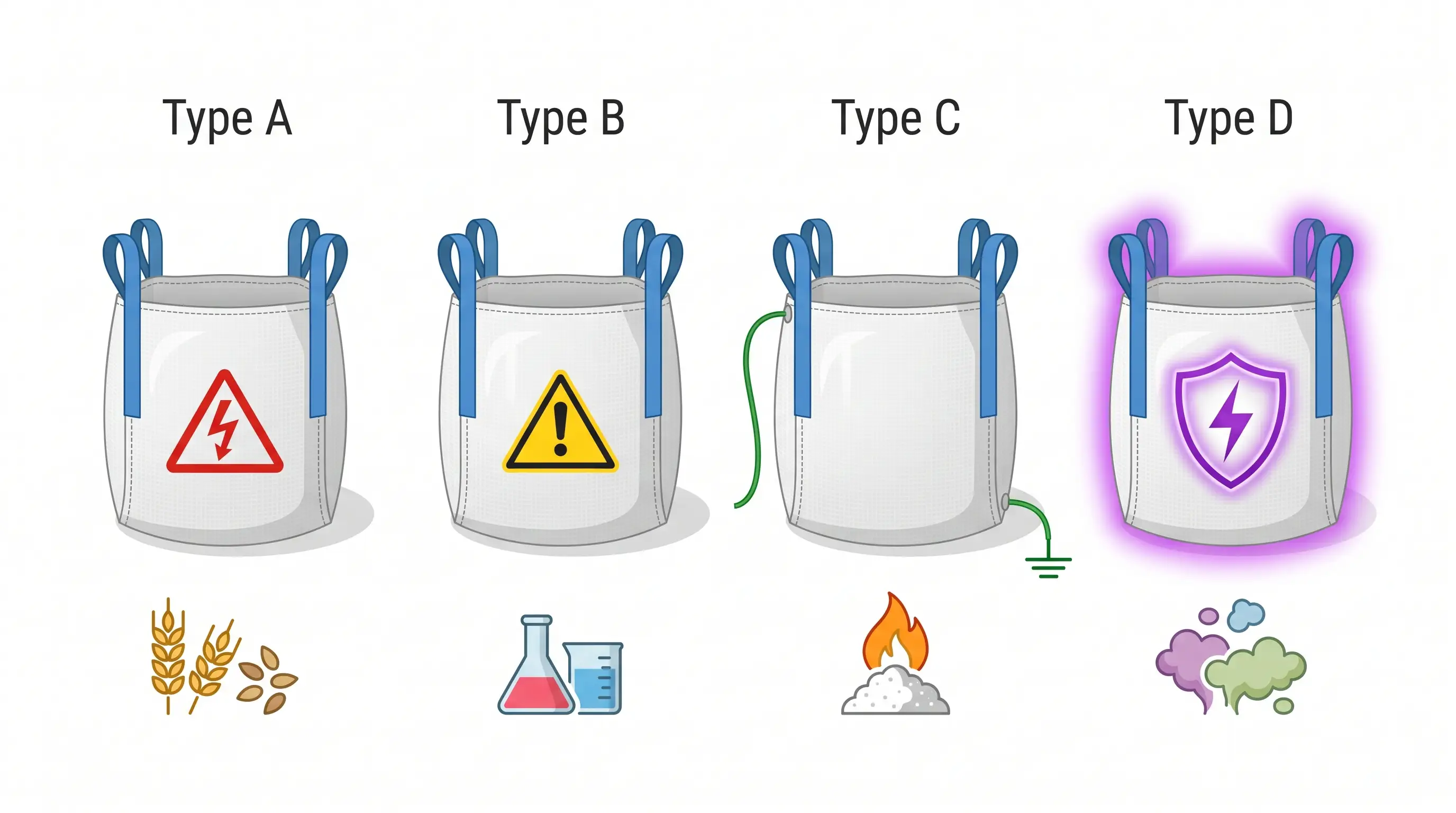
FIBC bags are classified into four types based on their ability to mitigate electrostatic risk during filling and discharging [^161^][^158^]. Choosing the correct type is critical for worker safety and preventing fires or product damage when handling combustible materials.
Made from plain woven polypropylene with no static protection. Type A FIBC bags do not reduce static build-up and should only be used for non-flammable materials in safe environments [^161^][^158^].
Uses fabric with low breakdown voltage (under 6kV) to reduce high-energy spark discharges. Type B bags resist energetic sparks but do not dissipate static charge [^161^][^166^].
Features conductive threads woven into the fabric in a grid pattern. Must be grounded during filling and emptying to safely dissipate static charge [^161^][^158^].
Made from antistatic fabric that passively dissipates charge into the air without grounding. Most practical choice for demanding flammable environments [^161^][^158^].
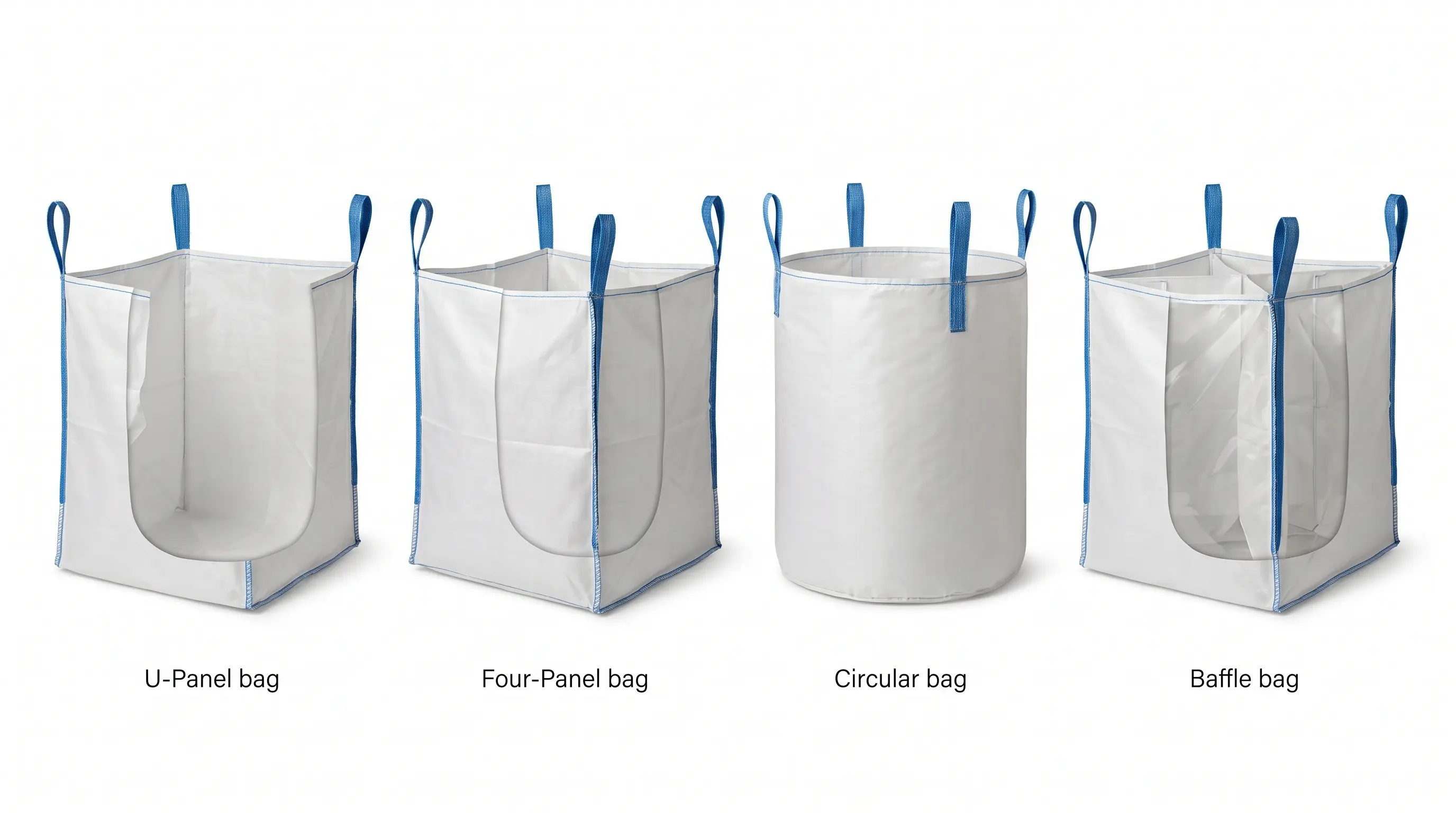
Beyond electrostatic types, FIBC bags are constructed in four main body styles, each offering different advantages for stacking, filling, and load distribution [^158^][^162^].
| Construction | Description | Advantages | Best For |
|---|---|---|---|
| U-Panel | One panel forms sides + base; two end panels sewn on | Durable, cost-efficient, good load distribution | General industrial use, agriculture |
| 4-Panel | Four individual panels sewn to form square shape | Best stacking stability, holds shape well | Warehouse storage, palletized shipping |
| Circular | Single tubular fabric piece with minimal seams | Minimal leakage risk, fewer seams | Fine powders, chemicals, food-grade |
| Baffle (Form-Stable) | Internal baffles sewn into corners | Maintains square shape, maximizes space | Container shipping, tight storage spaces |
Understanding FIBC electrostatic types is critical for safe bulk material handling. Type A offers no static protection for non-flammable goods. Type B reduces spark risk for dry powders. Type C requires grounding for flammable environments. Type D provides passive antistatic protection without grounding — the safest choice for hazardous materials.
Every FIBC bag is rated by its Safe Working Load (SWL) and Safety Factor (SF) — the two most critical specifications for safe operation [^159^][^163^].
Safe Working Load (SWL) is the maximum weight the bag is certified to carry under normal conditions. Safety Factor is the ratio between the bag's tested breaking strength and its SWL. For example, a 1000kg bag with 5:1 SF must withstand 5000kg in testing before failure [^159^].
| Safety Factor | Test Load | Use Case | Standard |
|---|---|---|---|
| 5:1 | 5x SWL | Single-use (one-way) bags for non-dangerous goods | ISO 21898 · IS 14738 |
| 6:1 | 6x SWL | Multi-trip bags, UN-certified hazardous goods | UN Regulations · EFIBCA |
| 8:1 | 8x SWL | Heavy-duty reusable, demanding service routes | Specialist Applications |
Small capacity · Agriculture · Food
Most popular · All industries · 1 Ton
Heavy duty · Chemicals · Construction
Extra heavy · Mining · Bulk material
Cyclic top-lift · Compression · Tensile
ISO 21898 · IS 14738 · UN Certified
FIBC bags come in standard and custom dimensions. The most common base dimension is 35" x 35" (90cm x 90cm), designed to fit standard pallets, with heights ranging from 42" to 60" (110cm to 150cm) depending on product density and capacity [^160^].
| Size (cm) | Size (inches) | Typical SWL | Volume | Common Use |
|---|---|---|---|---|
| 90 x 90 x 90 | 35" x 35" x 35" | 500kg – 750kg | 0.5 – 0.7 m³ | Food grains, seeds, small batches |
| 90 x 90 x 110 | 35" x 35" x 43" | 1000kg | 0.8 – 1.0 m³ | Most popular — chemicals, fertilizer, cement |
| 90 x 90 x 120 | 35" x 35" x 47" | 1000kg – 1250kg | 1.0 – 1.2 m³ | Low-density products, agriculture |
| 95 x 95 x 120 | 37" x 37" x 47" | 1250kg – 1500kg | 1.1 – 1.3 m³ | Construction material, chemicals |
| 100 x 100 x 120 | 39" x 39" x 47" | 1500kg – 2000kg | 1.2 – 1.5 m³ | Heavy minerals, mining, bulk chemicals |
FIBC jumbo bag prices in India vary based on size, SWL capacity, safety factor, construction type, liner requirements, and customization. Standard FIBC bags range from ₹250 to ₹600+ per piece for bulk orders [^167^].
| FIBC Type | Capacity | Safety Factor | Price Range (₹/pc) |
|---|---|---|---|
| Standard U-Panel FIBC | 500kg – 1000kg | 5:1 | ₹250 – ₹350 |
| Standard 4-Panel FIBC | 1000kg | 5:1 | ₹300 – ₹400 |
| Heavy Duty FIBC | 1000kg – 1500kg | 6:1 | ₹350 – ₹450 |
| Food-Grade FIBC with Liner | 500kg – 1000kg | 5:1 / 6:1 | ₹400 – ₹550 |
| UN Certified FIBC | 1000kg | 6:1 (Mandatory) | ₹450 – ₹600+ |
| Baffle / Form-Stable FIBC | 1000kg – 1500kg | 5:1 / 6:1 | ₹400 – ₹500 |
Note: Prices are indicative for bulk orders (500+ pieces). Final pricing depends on fabric GSM, printing requirements, PE liner type, loop configuration, and delivery location. Contact us for exact FIBC bag pricing for your specifications.
FIBC bags are constructed in four main body styles. U-panel bags offer durability and cost efficiency. 4-panel bags provide superior stacking stability. Circular bags minimize seams and leakage risk. Baffle bags maintain square shape for maximum space utilization in containers and warehouses.
FIBC bags are manufactured through a precise multi-step process using virgin polypropylene granules, UV stabilizers, and advanced weaving technology [^162^][^165^].
Polypropylene granules are melted and extruded into flat tapes (fibers). These tapes are stretched and cooled to achieve high tensile strength. UV stabilizers and color pigments are added during this stage for outdoor durability and branding [^162^].
The PP tapes are woven into fabric on circular looms. The weave density (typically 10×10 to 14×14) determines fabric strength. Fabric GSM ranges from 120 to 250 depending on SWL requirements [^162^][^165^].
For moisture-sensitive products, the woven fabric is laminated with a PP coating. This creates a moisture barrier while maintaining fabric flexibility [^165^].
The woven fabric is cut into precise panels using automated cutting machines. Dimensions are verified to ensure consistency across U-panel, 4-panel, or circular designs [^162^].
Company logos, SWL ratings, safety factors, handling instructions, and batch codes are printed using flexographic or rotogravure techniques for durability [^162^].
Thicker PP tapes are woven into lifting loops (handles). Standard configurations include 4-loop cross-corner, 4-loop side-seam, or 2-loop designs. Loop strength is tested to exceed SWL requirements [^165^].
Skilled workers sew panels, loops, filling spouts, and discharge bottoms together. Optional PE liners are inserted during assembly for food-grade and chemical applications [^162^][^165^].
Every batch undergoes rigorous testing: cyclic top-lift tests at 5x-6x SWL, compression/stacking tests, tensile strength checks, and UV resistance verification. Only bags passing all tests receive certification [^159^][^163^].
Dwarkesh Polyfab manufactures ISO-certified FIBC jumbo bags from our Morbi facility, serving clients across India and exporting to international markets.
No middlemen. Factory-direct FIBC pricing from Morbi, Gujarat with complete quality control over extrusion, weaving, and assembly.
All FIBC bags manufactured under ISO 9001:2015 with compliance to ISO 21898, IS 14738, and UN certification standards.
Complete range: Type A, B, C, D. U-panel, 4-panel, circular, and baffle constructions with SWL from 500kg to 2000kg.
Every batch tested for SWL, safety factor, UV resistance, and seam strength before dispatch. Test certificates provided.
Up to 6-color printing for branding, handling instructions, SWL markings, and UN codes on all FIBC bag types.
Fast delivery across Gujarat, Maharashtra, Rajasthan, and all Indian states. Export packing available for international shipments.
FIBC bags serve diverse industries worldwide due to their durability, cost-efficiency, and versatility in handling bulk materials.
A FIBC (Flexible Intermediate Bulk Container) jumbo bag is a large woven polypropylene bag designed for storing and transporting bulk materials. FIBC bags typically handle loads from 500kg to 2000kg and are used across agriculture, chemicals, construction, and food industries.
FIBC bags are classified into four electrostatic types: Type A (no static protection), Type B (low breakdown voltage), Type C (conductive, requires grounding), and Type D (antistatic, no grounding needed). By construction, they are U-panel, 4-panel, circular, and baffled bags.
FIBC jumbo bag prices in India range from ₹250 to ₹600+ per bag depending on size, SWL capacity, safety factor, construction type, and customization. Standard 1000kg FIBC bags typically cost between ₹300-₹450 per piece for bulk orders.
SWL stands for Safe Working Load — the maximum weight a FIBC bag is certified to carry under normal conditions. Common SWL ratings are 500kg, 1000kg, 1250kg, 1500kg, and 2000kg. The bag is tested to withstand 5x or 6x its SWL during quality control.
A 5:1 safety factor means the bag is tested to withstand 5 times its SWL before failure, suitable for single-use applications. A 6:1 safety factor withstands 6 times the SWL and is required for multi-trip use and UN-certified hazardous material transport.
The most common standard FIBC size is 90cm x 90cm x 110cm (35" x 35" x 43") with a 1000kg SWL. However, sizes range from 90x90x90cm for 500kg loads to 100x100x120cm for 2000kg loads depending on application requirements.
Use Type C bags when you have reliable grounding systems available and need conductive static protection for flammable materials. Use Type D bags when grounding is difficult or unreliable — they provide passive antistatic protection without requiring ground connection.
Yes, PE liners are available as an optional insert for all FIBC bag types. Liners provide moisture barrier protection for hygroscopic products, food-grade compliance, and chemical resistance. Liners can be tubular, form-fitted, or loose-insert depending on the application.
U-panel bags use one continuous panel for the sides and base plus two end panels, offering durability and cost efficiency. 4-panel bags use four separate panels sewn together, providing superior stacking stability and better shape retention when filled.
Yes, but only FIBC bags with a 6:1 or 8:1 safety factor are designed for multi-trip use. Bags must be inspected after each use for damage to loops, seams, or fabric. Single-use bags (5:1 SF) should not be reused as they are not tested for repeated stress cycles.
Need FIBC bags for your industry? Share your specifications — SWL, size, type, and quantity — and we will send you a competitive price quote within 24 hours. Direct manufacturer from Morbi, Gujarat.